TOP Contributors

  1. MIKROE (2784 codes)
  2. Alcides Ramos (405 codes)
  3. Shawon Shahryiar (307 codes)
  4. jm_palomino (133 codes)
  5. Bugz Bensce (97 codes)
  6. S P (73 codes)
  7. dany (71 codes)
  8. MikroBUS.NET Team (35 codes)
  9. NART SCHINACKOW (34 codes)
  10. Armstrong Subero (27 codes)

Most Downloaded

  1. Timer Calculator (142085 times)
  2. FAT32 Library (75309 times)
  3. Network Ethernet Library (59504 times)
  4. USB Device Library (49526 times)
  5. Network WiFi Library (45290 times)
  6. FT800 Library (44928 times)
  7. GSM click (31442 times)
  8. mikroSDK (30467 times)
  9. microSD click (27804 times)
  10. PID Library (27625 times)
Libstock prefers package manager

Package Manager

We strongly encourage users to use Package manager for sharing their code on Libstock website, because it boosts your efficiency and leaves the end user with no room for error. [more info]

< Back
mikroSDK Library

Charger 12 click

Rating:

5

Author: MIKROE

Last Updated: 2019-09-18

Package Version: 1.0.0.0

mikroSDK Library: 1.0.0.0

Category: Power supply

Downloaded: 4755 times

Not followed.

License: MIT license  

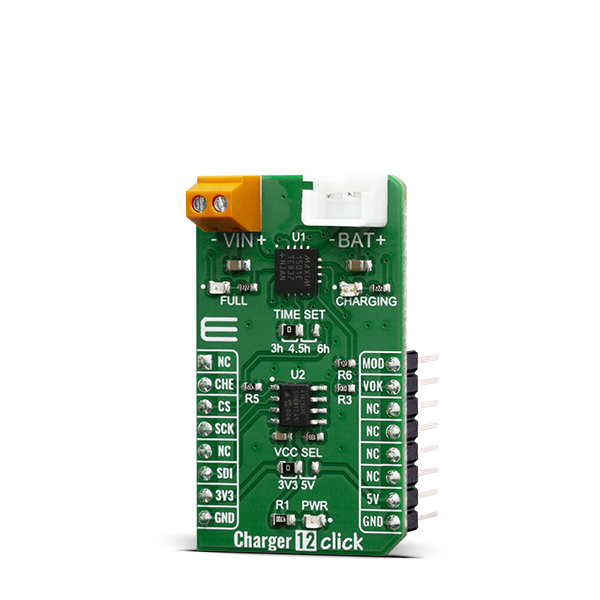
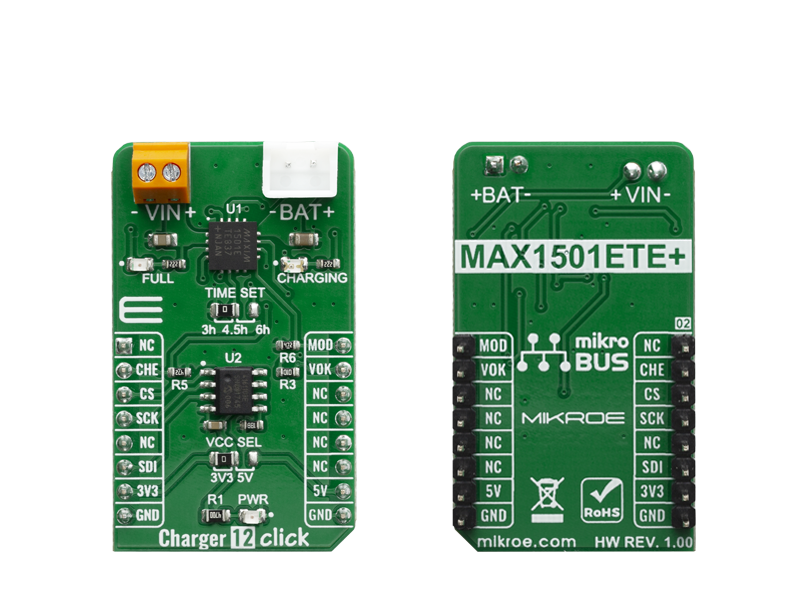
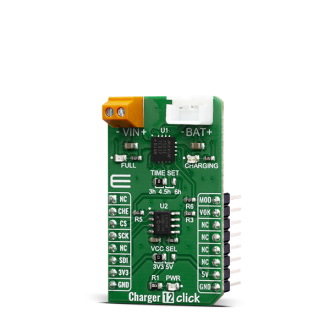
Charger 12 Click is a single lithium-ion (Li+) cell or three-cell NiMH/NiCd battery charger. This click can be used for Low-Cost Li-Ion battery chargers, or Power Tools, toys, backup energy storage solutions, etc.

No Abuse Reported

Do you want to subscribe in order to receive notifications regarding "Charger 12 click" changes.

Do you want to unsubscribe in order to stop receiving notifications regarding "Charger 12 click" changes.

Do you want to report abuse regarding "Charger 12 click".
  • mikroSDK Library 2.0.0.0
  • Comments (0)
DOWNLOAD LINK RELATED COMPILER CONTAINS
mikroBasic PRO for ARM
  • lib
  • src
  • exa
  • hlp
  • hex
  • sch
  • pcb
  • doc
mikroBasic PRO for AVR
  • lib
  • src
  • exa
  • hlp
  • hex
  • sch
  • pcb
  • doc
mikroBasic PRO for dsPIC30/33 & PIC24
  • lib
  • src
  • exa
  • hlp
  • hex
  • sch
  • pcb
  • doc
mikroBasic PRO for FT90x
  • lib
  • src
  • exa
  • hlp
  • hex
  • sch
  • pcb
  • doc
mikroBasic PRO for PIC
  • lib
  • src
  • exa
  • hlp
  • hex
  • sch
  • pcb
  • doc
mikroBasic PRO for PIC32
  • lib
  • src
  • exa
  • hlp
  • hex
  • sch
  • pcb
  • doc
mikroC PRO for ARM
  • lib
  • src
  • exa
  • hlp
  • hex
  • sch
  • pcb
  • doc
mikroC PRO for AVR
  • lib
  • src
  • exa
  • hlp
  • hex
  • sch
  • pcb
  • doc
mikroC PRO for dsPIC30/33 & PIC24
  • lib
  • src
  • exa
  • hlp
  • hex
  • sch
  • pcb
  • doc
mikroC PRO for FT90x
  • lib
  • src
  • exa
  • hlp
  • hex
  • sch
  • pcb
  • doc
mikroC PRO for PIC
  • lib
  • src
  • exa
  • hlp
  • hex
  • sch
  • pcb
  • doc
mikroC PRO for PIC32
  • lib
  • src
  • exa
  • hlp
  • hex
  • sch
  • pcb
  • doc
mikroPascal PRO for ARM
  • lib
  • src
  • exa
  • hlp
  • hex
  • sch
  • pcb
  • doc
mikroPascal PRO for AVR
  • lib
  • src
  • exa
  • hlp
  • hex
  • sch
  • pcb
  • doc
mikroPascal PRO for dsPIC30/33 & PIC24
  • lib
  • src
  • exa
  • hlp
  • hex
  • sch
  • pcb
  • doc
mikroPascal PRO for FT90x
  • lib
  • src
  • exa
  • hlp
  • hex
  • sch
  • pcb
  • doc
mikroPascal PRO for PIC
  • lib
  • src
  • exa
  • hlp
  • hex
  • sch
  • pcb
  • doc
mikroPascal PRO for PIC32
  • lib
  • src
  • exa
  • hlp
  • hex
  • sch
  • pcb
  • doc

mikroSDK Library Blog

Charger 12 click

Charger 12 click

Native view of the Charger 12 click board.

View full image
Charger 12 click

Charger 12 click

Front and back view of the Charger 12 click board.

View full image

Library Description

Library contains functions for getting and setting GPIO pin states Library contains function for mode selection Library contains function for SPI transfer operation Library contains function for SPI get register operation Library contains functions for incrementing and decrementing wiper position

Key functions:

  • uint8_t charger12_mode_select( uint8_t mode_select ) - selects device operation mode by setting RST(CHGEN) and PWM(MODE) pins
  • void charger12_spi_increment_wiper( void ) - increments wiper position by sending 8bit increment wiper command
  • void charger12_spi_decrement_wiper( void ) - decrements wiper position by sending 8bit decrement wiper command

Examples description

The application is composed of three sections :

  • System Initialization - Initializes GPIO pins, SPI and LOG modules
  • Application Initialization - Iniztializes SPI driver
  • Application Task - Executes additional functions based on user input
void applicationTask( )
{
    uart_ready = UART_Data_Ready( );

    if (uart_ready == 1)
    {
        uart_char = UART_Read( );

        switch (uart_char)
        {
            case '+' :
            {
                charger12_case_Plus( );
                break;
            }
            case '-' :
            {
                charger12_case_Minus( );
                break;
            }
            case '1' :
            {
                charger12_case_One( );
                break;
            }
            case '2' :
            {
                charger12_case_Two( );
                break;
            }
            case '3' :
            {
                charger12_case_Three( );
                break;
            }
            case '4' :
            {
                charger12_case_Four( );
                break;
            }
            default :
            {
                mikrobus_logWrite( "> Invalid command", _LOG_LINE );
                break;
            }
        }
    }
}

Additional Functions :

  • charger12_case_Plus() - Increments Wiper position
  • charger12_case_Minus() - Decrements Wiper position
  • charger12_case_One() - Selects 1st mode of operation
  • charger12_case_Two() - Selects 2nd mode of operation
  • charger12_case_Three() - Selects 3rd mode of operation
  • charger12_case_Four() - Selects 4th mode of operation

Other mikroE Libraries used in the example:

  • SPI
  • UART
  • Conversions

Additional notes and informations

Depending on the development board you are using, you may need USB UART clickUSB UART 2 click or RS232 click to connect to your PC, for development systems with no UART to USB interface available on the board. The terminal available in all MikroElektronika compilers, or any other terminal application of your choice, can be used to read the message.

ALSO FROM THIS AUTHOR

BEE Click

0

The Click is designed to run on 3.3V power supply only.

[Learn More]

ROTARY G Click

0

Rotary Click carries a 15-pulse incremental rotary encoder with detents, surrounded by a ring of 16 green LEDs. It’s a perfect solution for adding a precision input knob to your design. The encoder outputs A and B signals (out of phase to each other); the knob also acts as a push-button which sends an interrupt to the target board MCU. The LED ring is controlled through SPI lines (CS, SCK, MISO, MOSI). Rotary Click can be used with either a 3.3V or 5V power supply.

[Learn More]

Ambient 20 Click

0

Ambient 20 Click is a compact add-on board used to measure the amount of the present ambient light. This board features the BU27030NUC, a 16-bit digital-output ambient light sensor with an I2C interface from Rohm Semiconductor. The BU27030NUC has a flexible and wide operating range of up to 20klx with a maximum resolution of 0.0007lux/count, providing an excellent responsivity close to the human eyes' response. It also features inherent 50Hz/60Hz light noise rejection and excellent IR-cut characteristics for high robustness at high sensitivity.

[Learn More]