TOP Contributors

  1. MIKROE (2784 codes)
  2. Alcides Ramos (405 codes)
  3. Shawon Shahryiar (307 codes)
  4. jm_palomino (133 codes)
  5. Bugz Bensce (97 codes)
  6. S P (73 codes)
  7. dany (71 codes)
  8. MikroBUS.NET Team (35 codes)
  9. NART SCHINACKOW (34 codes)
  10. Armstrong Subero (27 codes)

Most Downloaded

  1. Timer Calculator (142156 times)
  2. FAT32 Library (75476 times)
  3. Network Ethernet Library (59612 times)
  4. USB Device Library (49624 times)
  5. Network WiFi Library (45371 times)
  6. FT800 Library (45081 times)
  7. GSM click (31491 times)
  8. mikroSDK (30592 times)
  9. microSD click (27907 times)
  10. PID Library (27645 times)
Libstock prefers package manager

Package Manager

We strongly encourage users to use Package manager for sharing their code on Libstock website, because it boosts your efficiency and leaves the end user with no room for error. [more info]

< Back
mikroSDK Library

Clock Gen 5 click

Rating:

5

Author: MIKROE

Last Updated: 2021-01-20

Package Version: 1.0.0.0

mikroSDK Library: 1.0.0.0

Category: Clock generator

Downloaded: 2725 times

Not followed.

License: MIT license  

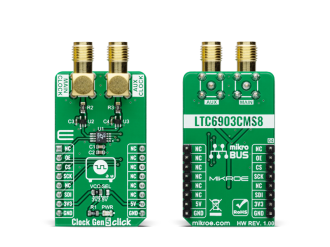
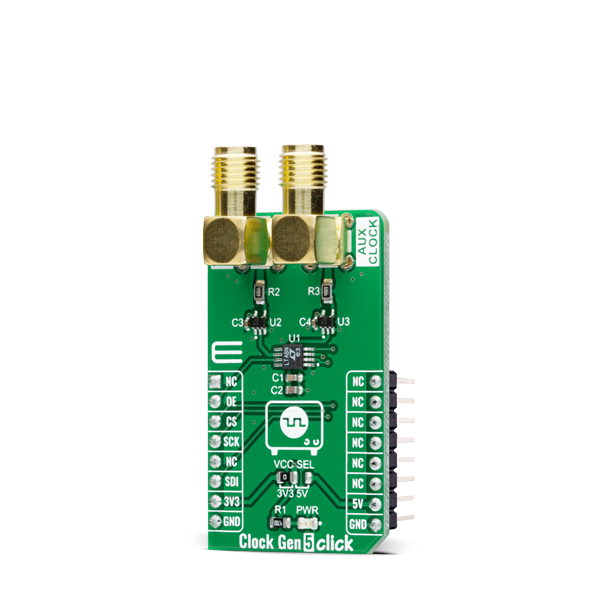
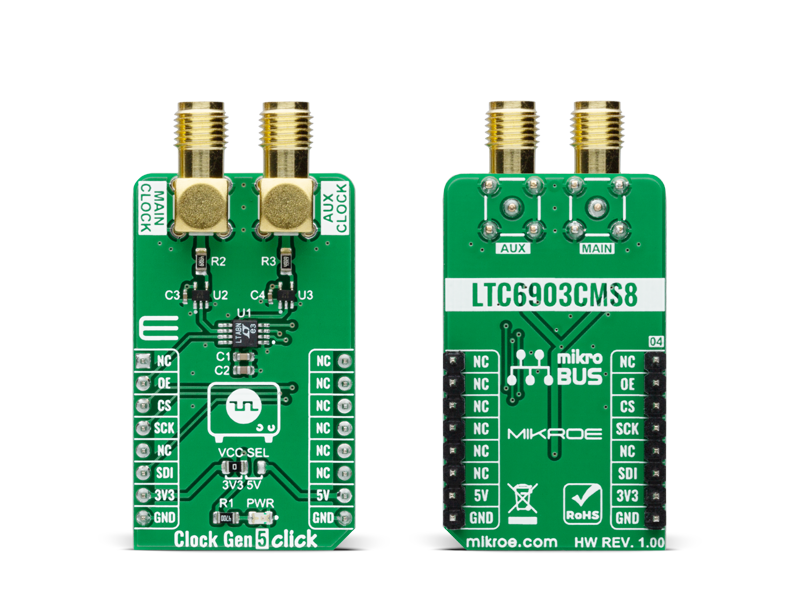
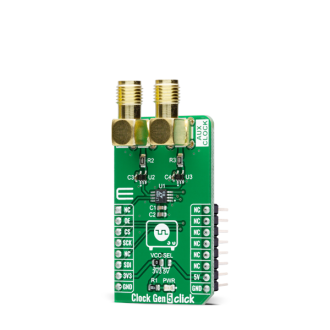
Clock Gen 5 Click is a compact add-on board that contains a digital programmable oscillator solution. This board features the LTC6903, a low-power self-contained digital frequency source providing a precision frequency from 1kHz to 68MHz set through a 3-wire SPI digital interface from Analog Devices.

No Abuse Reported

Do you want to subscribe in order to receive notifications regarding "Clock Gen 5 click" changes.

Do you want to unsubscribe in order to stop receiving notifications regarding "Clock Gen 5 click" changes.

Do you want to report abuse regarding "Clock Gen 5 click".
  • mikroSDK Library 2.0.0.0
  • Comments (0)
DOWNLOAD LINK RELATED COMPILER CONTAINS
mikroBasic PRO for ARM
  • lib
  • src
  • exa
  • hlp
  • hex
  • sch
  • pcb
  • doc
mikroBasic PRO for AVR
  • lib
  • src
  • exa
  • hlp
  • hex
  • sch
  • pcb
  • doc
mikroBasic PRO for dsPIC30/33 & PIC24
  • lib
  • src
  • exa
  • hlp
  • hex
  • sch
  • pcb
  • doc
mikroBasic PRO for FT90x
  • lib
  • src
  • exa
  • hlp
  • hex
  • sch
  • pcb
  • doc
mikroBasic PRO for PIC
  • lib
  • src
  • exa
  • hlp
  • hex
  • sch
  • pcb
  • doc
mikroBasic PRO for PIC32
  • lib
  • src
  • exa
  • hlp
  • hex
  • sch
  • pcb
  • doc
mikroC PRO for ARM
  • lib
  • src
  • exa
  • hlp
  • hex
  • sch
  • pcb
  • doc
mikroC PRO for AVR
  • lib
  • src
  • exa
  • hlp
  • hex
  • sch
  • pcb
  • doc
mikroC PRO for dsPIC30/33 & PIC24
  • lib
  • src
  • exa
  • hlp
  • hex
  • sch
  • pcb
  • doc
mikroC PRO for FT90x
  • lib
  • src
  • exa
  • hlp
  • hex
  • sch
  • pcb
  • doc
mikroC PRO for PIC
  • lib
  • src
  • exa
  • hlp
  • hex
  • sch
  • pcb
  • doc
mikroC PRO for PIC32
  • lib
  • src
  • exa
  • hlp
  • hex
  • sch
  • pcb
  • doc
mikroPascal PRO for ARM
  • lib
  • src
  • exa
  • hlp
  • hex
  • sch
  • pcb
  • doc
mikroPascal PRO for AVR
  • lib
  • src
  • exa
  • hlp
  • hex
  • sch
  • pcb
  • doc
mikroPascal PRO for dsPIC30/33 & PIC24
  • lib
  • src
  • exa
  • hlp
  • hex
  • sch
  • pcb
  • doc
mikroPascal PRO for FT90x
  • lib
  • src
  • exa
  • hlp
  • hex
  • sch
  • pcb
  • doc
mikroPascal PRO for PIC
  • lib
  • src
  • exa
  • hlp
  • hex
  • sch
  • pcb
  • doc
mikroPascal PRO for PIC32
  • lib
  • src
  • exa
  • hlp
  • hex
  • sch
  • pcb
  • doc

mikroSDK Library Blog

Clock Gen 5 Click

Clock Gen 5 Click

Native view of the Clock Gen 5 Click board.

View full image
Clock Gen 5 Click

Clock Gen 5 Click

Front and back view of the Clock Gen 5 Click board.

View full image

Library Description

The library covers all the necessary functions to control Clock Gen 5 Click board™. Library performs a standard SPI interface communication.

Key functions:

  • void clockgen5_out_enable ( uint8_t en_out ) - Enable output function.
  • void clockgen5_set_config ( uint8_t cfg ) - Set configuration function.
  • void clockgen5_set_freq ( float freq ) - Set frequency function.

Examples description

The application is composed of three sections :

  • System Initialization - Initializes SPI, set RST and CS pin as outputs, begins to write log.
  • Application Initialization - Initialization driver enables - SPI, set output configuration CLK + 180°, also write log.
  • Application Task - (code snippet) This is an example that demonstrates the use of the Clock Gen 5 Click board™. In this example, we adjusts different frequencies every 3 sec. Results are being sent to the Usart Terminal where you can track their changes.
void application_task ( )
{
    clockgen5_set_freq( 12000.0 );
    mikrobus_logWrite( "-----------------------", _LOG_LINE );
    mikrobus_logWrite( "        12.0 MHz       ", _LOG_LINE );
    Delay_ms( 3000 );

    clockgen5_set_freq( 8000.0 );
    mikrobus_logWrite( "-----------------------", _LOG_LINE );
    mikrobus_logWrite( "         8.0 MHz       ", _LOG_LINE );
    Delay_ms( 3000 );

    clockgen5_set_freq( 5500.0 );
    mikrobus_logWrite( "-----------------------", _LOG_LINE );
    mikrobus_logWrite( "         5.5 MHz       ", _LOG_LINE );
    Delay_ms( 3000 );
    
    clockgen5_set_freq( 2700.0 );
    mikrobus_logWrite( "-----------------------", _LOG_LINE );
    mikrobus_logWrite( "         2.7 MHz       ", _LOG_LINE );
    Delay_ms( 3000 );

    clockgen5_set_freq( 800.0 );
    mikrobus_logWrite( "-----------------------", _LOG_LINE );
    mikrobus_logWrite( "         0.8 MHz       ", _LOG_LINE );
    Delay_ms( 3000 );
    
    clockgen5_set_freq( 200.0 );
    mikrobus_logWrite( "-----------------------", _LOG_LINE );
    mikrobus_logWrite( "         0.2 MHz       ", _LOG_LINE );
    Delay_ms( 3000 );
}

Other mikroE Libraries used in the example:

  • SPI
  • UART

Additional notes and informations

Depending on the development board you are using, you may need USB UART clickUSB UART 2 click or RS232 click to connect to your PC, for development systems with no UART to USB interface available on the board. The terminal available in all MikroElektronika compilers, or any other terminal application of your choice, can be used to read the message.

ALSO FROM THIS AUTHOR

NeoMesh 868MHz Click

0

NeoMesh Click - 868MHz is a compact add-on board with a low-power, long-range transceiver, ideal for Mesh wireless networking. This board features the NC1000C-8, a wireless Mesh network module from NeoCortec. With an additional antenna that MikroE offers connected to the module’s u.Fl connector, you can create a fully functional wireless Mesh network node that will work in the Sub-GHz frequency band of 868MHz. The module has a generic application layer that can configured to suit applications.

[Learn More]

STSPIN220 Click

0

STSPIN220 Click is a stepper motor driver with the PWM current control and selectable microstepping up to 256 microsteps. It is based on the STSPIN220, a low voltage stepper motor driver from STSPIN2 series. It is optimized for battery-powered, low voltage motor driving applications, featuring the lowest standby current available on the market (max 80 nA). The STSPIN220 is a high-efficiency motor driver, featuring low ON resistance MOSFETs as the output stage, in a small 3x3mm QFN package. Its output stage implements the PWM current control with fixed OFF time, along with a full set of protection features. The device can be used with the step motor voltage ranging from 1.8V to 10V, and current up to 1.3A per bridge.

[Learn More]

mikroBlocks

1

Another project from our intern's lab, mikroBlocks is a clone of tetris developed from scratch.

[Learn More]